
The full history of The Concord is not a long tale given that The Five Realms only agreed to come and work together a few seasons ago. More important are the circumstances and events that lead to its founding in the year 220.
The Realms Apart
The realms of the Concord occupy a large part of middle Esterra, a landmass of vibrant and varied places. Massive diversity in terrain, danger, and wealth have doomed to failure any attempts throughout history to control the vast continent. Many nations have arisen and fallen to internal strife, conquest or the predations of the more insidious powers of the world. Some few great Empires have threatened to achieve unity, but all have collapsed back into small warring states.
The five founding realms of The Concord were such polities. Despite sharing the faith of the Church of the Divine Spheres their differences prevented any unity beyond limited migration and trade and as such each realm experienced its dangers without support from each other. The raiders of the Twinblade Confederacy and the wild invaders of Zekartaal were constant threats across the region for decades. Struggling alone against them forced the Realms into loose alliances but each still stood proudly independent, calling on aid only when needed and granting it in turn sometimes hesitantly. The new rising dangers of the Onyx Aristocracy and the Illsevir lead to loss after loss as the Realms found themselves unable to face so many aggressive dangers at once and each begging always for support without being able to countenance weakening their own defences. On the brink of complete destruction they were forced to consider any option for survival. A proposal was made. A proposal to strengthen their alliances. To unify.
More details on threats to The Concord can be found under The Peoples Beyond
The Concord is Signed
See also The Concordian Constitution
The Andashi and the folk of the Greenweald Baronies realised it first, though they argue about which side proposed their union. They had always traded easily between each other, and considered the other a friend. They had no competing interests, with the old empire having never touched the Greenweald, and the Baronies little interest in dampening the ambitions of Andash. When the Zekartaal, frustrated in their attempts to crush the Baronies, pushed out into the plains to claim ancient Imperial ruins the Andashi suffered some terrible losses. Tribal leaders reached out to the Barons for aid, and the Barons were eager to help against their ancient foe. A leaders from both sides gathered at the edge of the forest under the shade of a great tree and they signed the Pact of the Last Pine. Together they were able to halt the advance of the Tribes and force a stalemate at the border. Even together they could not prevent the spread of corruption and frequent raids across the borders of the alliance.
The Pact of Last Pine reached out to the Iron Valley, hoping to get Valleyfolk mercenaries to fight the Zekartaal for coin or other riches. Willing to offer support in theory the Iron Valley had been struggling with their own losses. The rising Illsevir had swiftly taken Alfwens Wall and Hjorvarths Rampart, forcing the Valleyfolk out of lands their ancestors had claimed for over a century. They sent their envoys in response to the Pact’s invitation and heard their pleas for aid in dismay. In a moment of well known humility, the envoy from the Valley admitted their own weakness and stated; “By the Spheres, our only hope is to forge a greater whole from these broken parts.”
Throwing their lot together but still not yet becoming one the three nations struggled against their enemies, but even their combined forces failed to prevent the losses continuing. In desperation they sent envoys to all nations wide across plain, mountain and forest begging any who need aid to come to meet together where the Iron Valley opens out on the Greenweald.
The First Summit.

Over the following year four more summits would follow. What was originally intended to be a regional web of alliances and trade support grew deeper as the situation became increasingly dire. Zekartaal took Villacres from the Andashi. The blockade of the bay forced Lerona Mere into irrelevance, and then revolution and sudden isolation and fear of reprisal from their scorned rulers. Baelags Holdfast fell to the Illsevir, leaving Windholme open to raids. Finally the first knightly delegation of Bordevar arrived, lowering their banners, admitting weakness and shame. After years of aloof distance they begged entry to the forming alliance seeking redemption. It was the Greenweald concept of Erfoderlich that gave the path forward. A moment of great peril, of great danger and risk to all. Everyone must be willing to sacrifice not just wealth and safety, but sovereignty so that all can survive. All struggled to accept the loss of independence, especially the citizens of Lerona Mere, but years of failure and a single season of great risk, left little choice. All agreed. Five would become one. The Concord.
The year that followed saw the formation of a central government formed of hundreds of volunteers from across the Realms and committed to the success of the alliance. These worthies took to giving up parochial identities, naming themselves Concordians. The only way that an endeavour such as this would succeed was if this information could be brought together, to make the hard choices and to try push back a dark fate. As summer turns to winter in the year 221, worthies of Realms are called to attend the first true Summit. A gathering at which the fragile processes of the new nation will be tested. The fate of their peoples resting upon those who travel to represent them. Or perhaps the weight of responsibility will crush the hopeful experiment with mistake after mistake. Or perhaps in the crucible of that fear champions will rise to the challenge and lay the foundation of a powerful nation to shelter all who follow the Spheres from their enemies..
Now is the time for the last desperate experiment to save the Realms.
Now is the time for The Concord.
The Concord's Function
The process of drawing together these disparate realms over the previous year was one predominantly consumed by bureaucracy, economic concerns and the questions of sovereignty. What has emerged from that may not be the most ideal, or effective solution, but it is one that was found to be the most agreeable to the most people.
Rulership
The greatest loss for many of the Realms in joining the Concord was releasing ultimate sovereignty to The Concords new governing councils. Under the agreement of The Concord, there can be no Realmic leaders with a higher status than the regional senators that represent those regions at The Concord, excluding the Concordian Throne, an individual who can be elected should the Senate decree they are required.
There are Five Councils of The Concord, they are as follows;
The Senate
The Senate stands as The Concords highest governmental council and its primary legislative body. It is the power of the Senate to pass laws, decree expenditures of the treasury, control foreign policy and make the highest decisions of The Concord. The Senate is made up of Senators who each represent a region held by The Concord and are elected by the cultures of their Realm. They generally serve for a term of two years.
The War Chamber
The War Chamber exists to operate and control the wars that The Concord might force or be forced into, upon its foes. It commands armies and fleets, splits up the spoils of war, assesses Confluxes and ordains field commanders. The War Chamber is made up of Admirals, Generals, Champions and their staff. The War Chamber also works closely with the Shardcircle to control and use the Waystones to their best effect. A group of War Chamber scouts known as Concordian Pathfinders travel far and wide to ensure that Waystone portals don’t get people killed.
The Church of Divine Spheres
The Church is the religious heart of The Concord. It responds to the moral concerns of the people, while also ensuring that the other elements of The Concords political structure remain upright through its extensive political powers. The Church is made up of all the priests and religious workers that attend a summit. The Church is also an international organisation, being beholden to the headquarters of the church in distant Artebazzan.
The Shardcircle
The Shardcircle is an organisation of arcane spellcasters who act as The Concords magical advisors. They research new magical techniques, provide arcane support and control a powerful portal known as The Precipice, which allows for the travel of power extra-planar beings. The Shardcircle meets in a hall somewhere outside the Mortal Sphere, where they can study in peace. Any citizen who can reach the Shardcircle here is considered a member.
The Exchange
The Exchange stands separate from the other Councils to limit their power. It controls powerful resources and operates a vast web of mercantile agreements. It also operates as the largest market in the land, purchasing, storing and selling unique resources and goods for trade. The Exchange’s Acquisitions Department travels as far and wide as Pathfinders, retrieving goods to be sold at the Summit’s Public Auctions.
Resident Citizens
Concordians are those citizens that have put aside their citizenship with the Realms of The Concord to assist with the nation's function. They act as bureaucrats, advisors and organisers for the various functions of The Concord.
Trade
Part of forming The Concord was consolidating trade within the polity for ease and growth. As such a new series of currency and promissory notes was created and administered by The Exchange.
The Coins
The Exchange has been in the process of replacing the many currencies spread across the Concord with the new series of Concordian coins. They are as follows.
-
 One Key
-
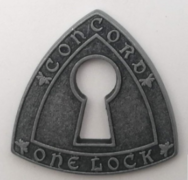 One Lock
-
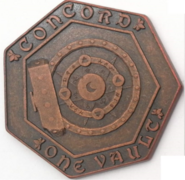 One Vault


Key
- The smallest unit of currency, one key is often enough for a simple meal, task or good. Most citizens would deal primarily in Keys.
Lock
- A more substantial coin, Locks are often used by merchants, tradesfolk and those of moderate wealth. 10 Keys make up 1 Lock, and 30 Locks make up 1 Vault
Vault
- The largest and wealthiest coin, Vaults are used by the obscenely wealthy, the powerful and the Concordian Treasury.
Promissory Notes
The Exchange has also begun to issue promissory notes for the various raw resources that it stores in its warehouses in Passage. These tend to come in two forms:
Measures
Small notes which refer to a portion of resources used in artisan work, apothecaries craft or surgical operations. The amount they refer to is often small, seldom more than a handful. The use of notes facilitates greater storage and ensures that fragile or perishable goods are not in danger.
Wains
Far larger notes which refer to a large amount of either Mithril, Arcstone or Thunder Oak, which are strategic resources of great importance. Each wain is approximately 1 tonne of the respective resource. These notes make trading such goods possible without transporting prohibitively heavy amounts of material around.
Law
(See also Law in Concord )
The legal code of The Concord, like any nation, is a lengthy document that would equal or exceed this document. However there is an amount that can be said about crime and punishment within the newly established Concord.
Crime
Crimes within The Concord tend to fall into four categories within The Concord. See also Law in Concord for more details. They are as follows:
- Crimes against Persons
- Violence or any other unsanctioned interaction between two or more individuals. Crimes such as brawling, murder, halting access to healing or other such altercations. It is important to note that consensual duelling even if it results in death is legal within The Concord.
- Crimes against Property
- Damage, theft and fraud to or involving objects. This includes simple theft, arson and even failure to honour contracts. Depending on where you are and who is involved, these crimes may be held to a greater or lesser concern.
- Crimes against The Concord
- Treason and subterfuge. This includes spying, disrupting the functions of Concordian Councils or sabotage. These crimes, while ranging in their damage, are generally viewed harshly.
- Crimes against The Spheres
- Heresy. This includes Prosthelytizing a different religion to the Divine Spheres, Spirit-harm and necromancy. These crimes are generally administered by The Church through the powers of Inquisition or Excommunication, but also carry a criminal charge as well, although one that will be heavily informed by the findings of the Church.
These definitions of crime are in the process of being made universal across The Concord, however a shortage of Concordians and deep cultural histories makes this a piecemeal effort. This understanding will be most stringent in the capital of Passage, and less enforced the further away you travel. Although regions may have their own understandings of what is and is not a crime.
Punishment
Due to the variation in cultures and circumstances across The Concord, it can be difficult to maintain a continuous legal tradition. What follows is how law enforcement and punishment is intended to work, and how it works in Passage.
All citizens of The Concord are entrusted with the power to arrest individuals and bring them before authorities for trial. Flippant arrests may be subject to their own investigations and
Concordians reserve the right to call for investigations for such, or other, actions. Trials will be presided over by at least a pair of Concordians who may call for witnesses, evidence or other such aspects of a trial before passing a verdict.
Punishments range from fines, reparations and humiliation for minor offences but may extend upwards towards banishment, excommunication, cursing or death if the circumstance calls for it.